


Article
Normandy Self-Guided Tour
The Best D-Day Beaches Itinerary by Car, Train or Bike
 Planning a Normandy self-guided tour is one of the most rewarding ways to explore the D-Day landing beaches at your own pace. Instead of following a fixed group schedule, you can spend longer at the places that move you most, pause for quiet reflection, and build your route around the museums, memorials and coastal towns that matter to you.
This guide focuses on the historic D-Day sites of Normandy, including Omaha Beach, Utah Beach, Pointe du Hoc, Sainte-Mère-Église, Arromanches, Juno Beach and the Normandy American Cemetery. It can be used as a one-day self-drive itinerary, a slower two or three-day route, or a flexible base for travellers staying in Bayeux, Caen or Carentan.
The five D-Day landing beaches were Utah, Omaha, Gold, Juno and Sword, stretching across the Normandy coast. On 6 June 1944, Allied forces landed across these beaches in one of the most significant operations of the Second World War.
Why Choose a Self-Guided Tour of Normandy?
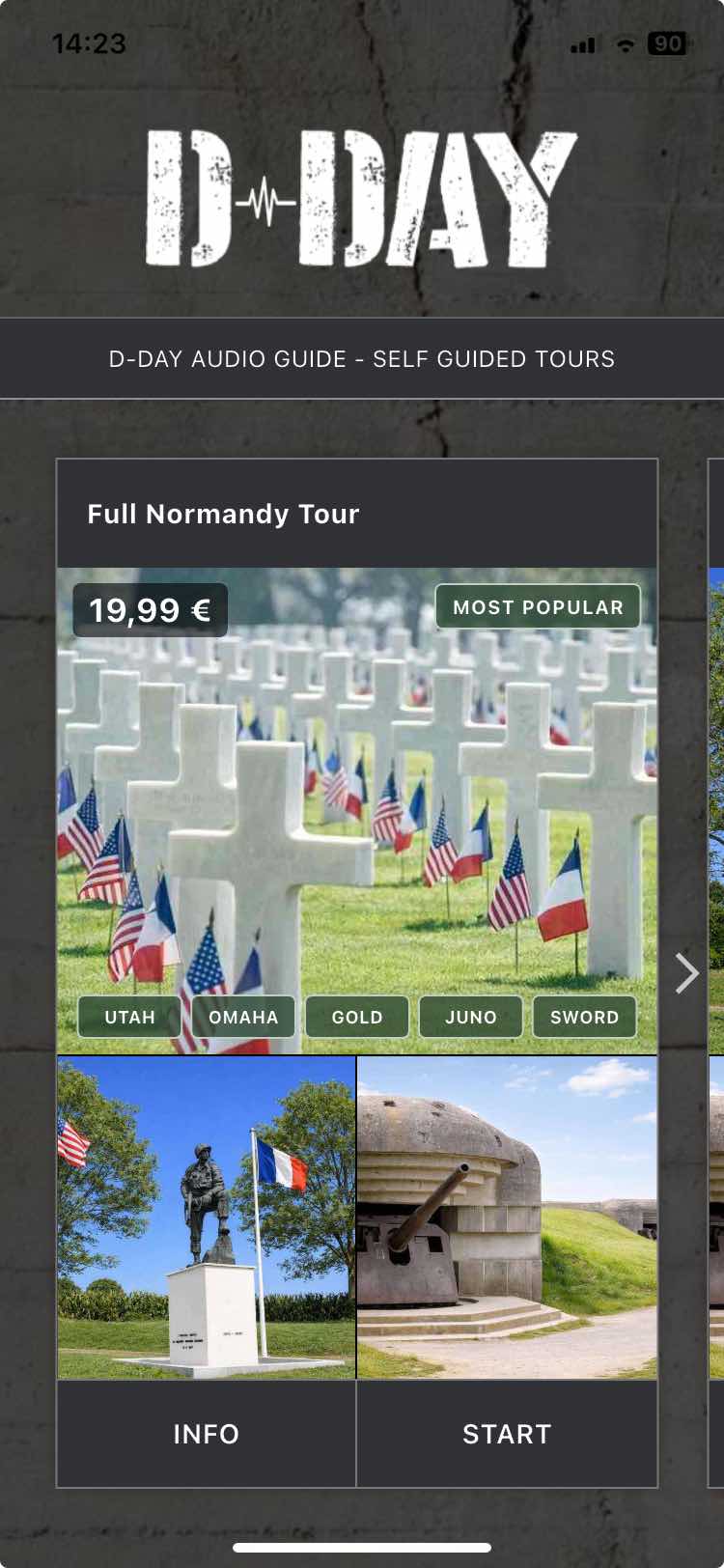 A self-guided Normandy tour gives you freedom. You decide when to start, how long to spend at each site, where to stop for lunch, and whether your focus is American, British, Canadian, airborne, naval or civilian history.
It is especially useful if you want to:
- Explore the D-Day beaches by car without rushing
- Visit both famous and lesser-known sites
- Spend more time in museums or cemeteries
- Travel independently from Bayeux, Caen or Paris
- Combine the D-Day beaches with Mont-Saint-Michel, Bayeux or Honfleur
- Avoid the cost or schedule of a private guided tour
A guided tour can be valuable if you want expert battlefield interpretation, but a self-guided itinerary works very well for visitors who enjoy planning, driving and reading background history before they arrive.
Best Base for a Normandy Self-Guided D-Day Tour
 For most visitors, Bayeux is the best base for a self-guided tour of the Normandy beaches. It is central, attractive, easy to walk around in the evening, and close to Omaha Beach, Arromanches and the American Cemetery.
Bayeux is best for: first-time visitors, D-Day beaches, restaurants, museums and a charming historic town.
Caen is best for: train connections, the Caen Memorial Museum and travellers without a car.
Carentan is best for: Utah Beach, Sainte-Mère-Église and airborne history.
Normandy Tourism also highlights Caen, Bayeux and Carentan as useful hubs for reaching the landing beaches by public transport, bicycle and on foot.
One-Day Normandy Self-Guided Tour Itinerary
This one-day route is ideal if you have a rental car and want to see the most important American D-Day sites in a single day.
Stop 1: Sainte-Mère-Église
 Start your day in Sainte-Mère-Église, one of the most famous towns associated with the airborne landings. The town is closely linked with the American paratroopers who landed in the early hours of D-Day.
Visit the church square, walk the surrounding streets and allow time for the Airborne Museum if you want a deeper understanding of the airborne operations before the beach landings.
Suggested time: 1 to 2 hours
Stop 2: Utah Beach
From Sainte-Mère-Église, continue to Utah Beach. This is one of the two American landing beaches and is often easier to absorb than Omaha because the surrounding landscape is more open and less dramatic.
The Utah Beach area is a good place to begin understanding the geography of the invasion. You can walk the beach, visit the museum and see memorials close to the original landing zone.
Suggested time: 1 to 1.5 hours
Stop 3: Pointe du Hoc
Pointe du Hoc is one of the most powerful stops on any Normandy self-guided tour. Set on cliffs between Utah and Omaha beaches, it was the site of a daring U.S. Ranger assault. The landscape still shows bomb craters, bunkers and German defensive positions.
The Pointe du Hoc Ranger Monument stands on a cliff west of the Normandy American Cemetery and overlooks Omaha Beach.
Suggested time: 45 minutes to 1 hour
Stop 4: Omaha Beach
Omaha Beach is one of the most emotional places to visit in Normandy. The beach is peaceful today, but standing on the sand and looking back toward the bluffs gives a sense of the scale and difficulty of the landings.
Good stopping points include the Omaha Beach Memorial, Les Braves sculpture and the nearby village of Saint-Laurent-sur-Mer.
Suggested time: 45 minutes to 1 hour
Stop 5: Normandy American Cemetery
 Finish your day at the Normandy American Cemetery in Colleville-sur-Mer. It overlooks Omaha Beach and is one of the most moving places in Normandy.
The cemetery is open daily except 25 December and 1 January, with public opening hours listed as 9 a.m. to 5 p.m.; admission ends 30 minutes before closing.
Suggested time: 1 to 1.5 hours
Suggested One-Day Route Summary
Morning: Sainte-Mère-Église and Utah Beach
Midday: Pointe du Hoc
Afternoon: Omaha Beach and Normandy American Cemetery
Best base: Bayeux, Caen or Carentan
Best transport: Rental car
Ideal pace: Full day, starting by 8:30 or 9:00 a.m.
This route is manageable in one day, but it is not the whole story of D-Day. It focuses mainly on the American sector. To see Gold, Juno and Sword beaches as well, allow at least two or three days.
Two-Day Normandy Self-Guided Tour
A two-day route gives you a much better sense of the full D-Day coastline.
Day 1: American Sector
Sainte-Mère-Église
Utah Beach
Pointe du Hoc
Omaha Beach
Normandy American Cemetery
Day 2: British and Canadian Sector
Arromanches-les-Bains
Longues-sur-Mer Battery
Gold Beach
Juno Beach Centre
Sword Beach
Pegasus Bridge
This second day adds the British and Canadian landing areas and helps you understand the invasion as a wider Allied operation, not only an American story.
Three-Day Normandy Self-Guided Tour
For the best experience, spend three days in the region.
Day 1: Utah and Airborne Sites
Focus on Sainte-Mère-Église, Utah Beach, Carentan and nearby airborne locations.
Day 2: Omaha and Pointe du Hoc
Visit Pointe du Hoc, Omaha Beach, the Normandy American Cemetery and nearby museums.
Day 3: Gold, Juno and Sword
Explore Arromanches, the remains of the Mulberry Harbour, Longues-sur-Mer, Juno Beach, Sword Beach and Pegasus Bridge.
A three-day itinerary gives you time to read, reflect and avoid rushing through sites that deserve more than a quick photo stop.
Can You Visit the Normandy Beaches Without a Car?
Yes, but it requires more planning. A car is the easiest way to visit multiple D-Day sites in one day, especially Pointe du Hoc, Omaha Beach and the smaller memorials. However, Normandy Tourism notes that key hubs such as Caen, Bayeux and Carentan can be used for car-free access by train, bus, bicycle and walking routes.
Without a car, the best approach is to:
- Stay in Bayeux or Caen
- Use trains to reach the region
- Choose one or two focused areas per day
- Consider bike hire for local exploration
- Use taxis or local buses for harder-to-reach sites
- Join a half-day guided tour only where public transport is limited (on average 75€ per person)
- A car-free self-guided trip is possible, but it is slower and works best if you are not trying to see every beach in one day.
Practical Tips for a Self-Guided Normandy Tour
Start early, especially in summer. Distances look short on a map, but museums, lunch stops, parking and quiet time at memorials all add up.
Check museum and cemetery opening times before you travel. Hours can vary by season, and some smaller museums close for lunch or have reduced winter schedules.
Do not try to see all five landing beaches in one day unless you only want brief stops. A focused route is more meaningful than a rushed checklist.
Bring layers. Normandy weather can change quickly, especially along the coast.
Download maps in advance. Rural roads are easy to drive, but mobile signal can vary around smaller villages and coastal areas.
Allow emotional space. The cemeteries, beaches and battlefield sites are not ordinary tourist attractions. Give yourself time to take them in.
Best Time of Year to Visit the Normandy D-Day Beaches
The Normandy beaches can be visited year-round, but the experience changes by season.
April to June is one of the best periods, with longer days and meaningful commemorative events around the D-Day anniversary.
July and August bring warmer weather but also more visitors.
September and October are excellent for a quieter trip, with comfortable conditions and fewer crowds.
Winter can be atmospheric and peaceful, but daylight is shorter and some attractions may have reduced hours.